
Performance evaluation of peer-assisted MPEG-DASH streaming in multi-user mobile scenarios
Performance evaluation of peer-assisted MPEG-DASH streaming with multiple concurrent users in mobile scenarios.

From the network layer to the viewer’s perception.
MPEG-DASH bitrate adaptation algorithms such as Look Ahead, variable-bitrate encoding and server-side representation switching.
Live delivery with LL-DASH and SRT, chunked transfer and delay-aware switching to keep latency low without stalls.
Objective QoE models validated with subjective tests, ITU-T P.1203, 3D video and QoE-as-a-Service for 5G vehicular scenarios.
Hybrid P2P distribution for DASH with WebRTC and Service Workers (SwarmLayer), transparent to existing players.
File delivery over unidirectional and multicast channels with FLUTE and AL-FEC (LDPC), background push and hybrid broadcast/broadband networks.
QoS-aware routing and video in mobile ad hoc networks, energy-efficient protocols and Energy Efficient Ethernet for streaming servers.
Performance evaluation of peer-assisted MPEG-DASH streaming with multiple concurrent users in mobile scenarios.

SwarmLayer is a hybrid P2P layer for MPEG-DASH that uses WebRTC and Service Workers to offload up to 96% of server traffic with no changes to existing players.
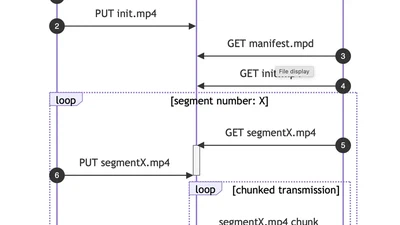
SSRS for LL-DASH live streaming uses server-measured client request delays to adapt video quality, achieving good quality-latency trade-offs without player modifications.

The Look Ahead ABR algorithm for DASH streaming leverages variable bitrate information from constant-quality encodings to minimize stalls while maintaining high QoE, outperforming …

Three new objective QoE models for DASH based on PSNR and VMAF, validated subjectively and via the Look Ahead ABR algorithm, outperforming existing models.

Multimedia Communications Group (COMM)
Institute of Telecommunications and Multimedia Applications (iTEAM)
Building 8G, Access D, Floor 4 – Universitat Politècnica de València
Camino de Vera, s/n
46022 Valencia, Spain