Pau Arce

Pau Arce

Associate Professor
Pau Arce Vila received his Telecommunications Engineering degree in 2005, his M.S. in Communication Technologies, Systems and Networks in 2008, and his PhD in Telecommunications in 2014, all from the Universitat Politècnica de València (UPV), Spain. He is a Profesor Permanente Laboral in the Communications Department at UPV and a researcher at the Institute of Telecommunications and Multimedia Applications (iTEAM) since 2005. His research interests include multimedia QoS, adaptive video streaming (DASH), quality of experience, routing in wireless ad hoc networks, and performance evaluation of multimedia systems.
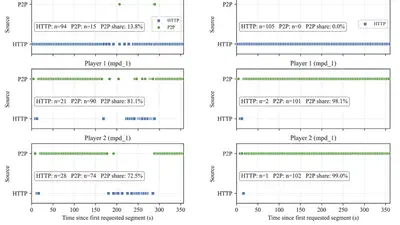
Performance evaluation of peer-assisted MPEG-DASH streaming in multi-user mobile scenarios featured image

Performance evaluation of peer-assisted MPEG-DASH streaming in multi-user mobile scenarios

Performance evaluation of peer-assisted MPEG-DASH streaming with multiple concurrent users in mobile scenarios.


avatar
Román Belda
•
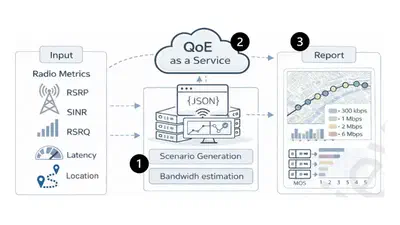
From Radio Telemetry to Perceptual Quality: A QoE-as-a-Service Framework for Multi-User OTT Streaming in 5G Vehicular Environments featured image

From Radio Telemetry to Perceptual Quality: A QoE-as-a-Service Framework for Multi-User OTT Streaming in 5G Vehicular Environments

A QoE-as-a-Service framework for 5G vehicular environments that maps radio telemetry to perceptual video quality metrics, enabling network-side QoE monitoring for OTT streaming …

avatar
Juan Carlos Guerri
•
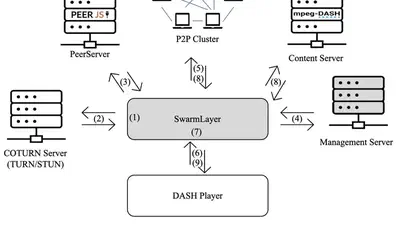
SwarmLayer: A Hybrid P2P Assisted Solution for MPEG-DASH Streaming featured image

SwarmLayer: A Hybrid P2P Assisted Solution for MPEG-DASH Streaming

SwarmLayer is a hybrid P2P layer for MPEG-DASH that uses WebRTC and Service Workers to offload up to 96% of server traffic with no changes to existing players.
avatar
Román Belda
•
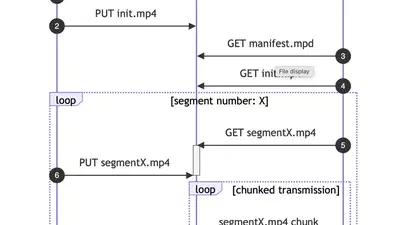
A DASH server-side delay-based representation switching solution to improve the quality of experience for low-latency live video streaming featured image

A DASH server-side delay-based representation switching solution to improve the quality of experience for low-latency live video streaming

SSRS for LL-DASH live streaming uses server-measured client request delays to adapt video quality, achieving good quality-latency trade-offs without player modifications.
avatar
Román Belda
•
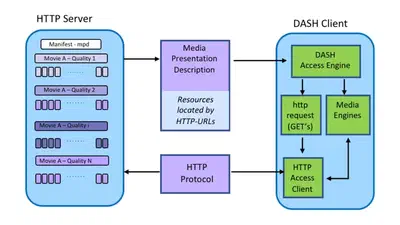
DASH Streaming traffic influence over energy efficient ethernet to improve energy savings featured image

DASH Streaming traffic influence over energy efficient ethernet to improve energy savings

Dynamic Streaming over HTTP (DASH) is the main standard used in online video streaming services, given that more than 1.2 billion pay subscribers around the world use this …

avatar
Tito R. Vargas
•
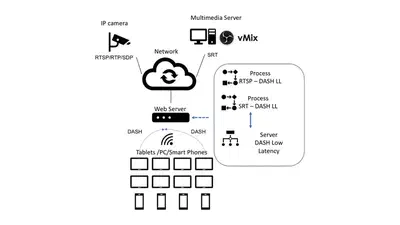
Performance Evaluation and Testbed for Delivering SRT Live Content using DASH Low Latency Streaming Systems featured image

Performance Evaluation and Testbed for Delivering SRT Live Content using DASH Low Latency Streaming Systems

A testbed for evaluating LL-DASH live streaming from SRT/RTSP sources, achieving end-to-end delays under 2 seconds using FFmpeg and open-source players.
avatar
Román Belda
•
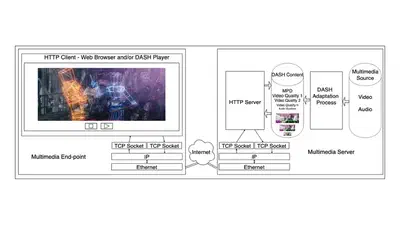
Study on the Impact of DASH Streaming Services using Energy Efficient Ethernet featured image

Study on the Impact of DASH Streaming Services using Energy Efficient Ethernet

Dynamic Streaming over HTTP is the main standard used for online video streaming, service that has about 1.1 billion subscribers around the world. That implies billions of …
avatar
Tito R. Vargas
•
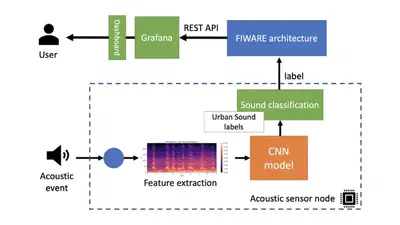
FIWARE based low-cost wireless acoustic sensor network for monitoring and classification of urban soundscape featured image

FIWARE based low-cost wireless acoustic sensor network for monitoring and classification of urban soundscape

This work presents a wireless acoustic sensor network (WASN) that monitors urban environments by recognizing a given set of sound events or classes. The nodes of the WASN are …

avatar
Pau Arce
•
Uso de contenedores Docker en el entorno educativo featured image

Uso de contenedores Docker en el entorno educativo

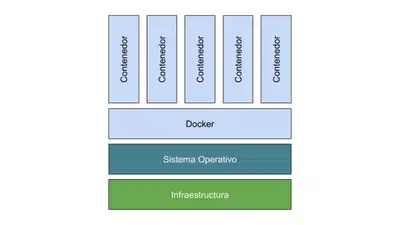
Using Docker containers in university lab courses to provide reproducible, cross-platform environments that simplify deployment of complex networking scenarios for students.

avatar
Ismael de Fez
•
A Low-cost Wireless Acoustic Sensor Network for the Classification of Urban Sounds featured image

A Low-cost Wireless Acoustic Sensor Network for the Classification of Urban Sounds

We present in this paper a wireless acoustic sensor network (WASN) that recognizes a set of sound events or classes from urban environments. The nodes of the WASN are Raspberry Pi …

David Salvo
•