Proxy-based near real-time TV content transmission in mobility over 4G with MPEG-DASH transcoding on the cloud
January 1, 2019·


 ,·
0 min read
Pau Arce
Ismael de Fez
Román Belda
Juan Carlos Guerri
Salvador Ferrairó
Abstract
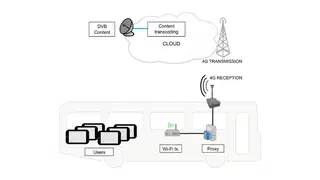
This paper presents and evaluates a system that provides TV and radio services in mobility using 4G communications. The system has mainly two blocks, one on the cloud and another on the mobile vehicle. On the cloud, a DVB (Digital Video Broadcasting) receiver obtains the TV/radio signal and prepares the contents to be sent through 4G. Specifically, contents are transcoded and packetized using the DASH (Dynamic Adaptive Streaming over HTTP) standard. Vehicles in mobility use their 4G connectivity to receive the flows transmitted by the cloud. The key element of the system is an on-board proxy that manages the received flows and offers them to the final users in the vehicle. The proxy contains a buffer that helps reduce the number of interruptions caused by hand over effects and lack of coverage. The paper presents a comparison between a live transmission using 4G connecting the clients directly with the cloud server and a near real-time transmission based on an on-board proxy. Results prove that the use of the proxy reduces the number of interruptions considerably and, thus, improves the Quality of Experience of users at the expense of slightly increasing the delay.
Type
Publication
Multimedia Tools and Applications, 78(18), 26399–26425. Springer

Authors
Associate Professor
Pau Arce Vila received his Telecommunications Engineering degree in 2005, his M.S. in Communication Technologies, Systems and Networks in 2008, and his PhD in Telecommunications in 2014, all from the Universitat Politècnica de València (UPV), Spain. He is a Profesor Permanente Laboral in the Communications Department at UPV and a researcher at the Institute of Telecommunications and Multimedia Applications (iTEAM) since 2005. His research interests include multimedia QoS, adaptive video streaming (DASH), quality of experience, routing in wireless ad hoc networks, and performance evaluation of multimedia systems.

Authors
Associate Researcher · Master’s Director at VIU
Ismael de Fez was born in Valencia, Spain in 1983. He received his Telecommunications Engineering degree in 2007 and his M.S. in Telematics in 2010 from the Universitat Politècnica de València (UPV), where his M.Sc. thesis was awarded by the Telefónica chair of UPV. He obtained his PhD in Telecommunications from UPV in 2014 and an MBA from UPV in 2017. He worked as an R&D Engineer at the Institute of Telecommunications and Multimedia Applications (iTEAM, UPV) from 2008 to 2021. Since 2021 he has been Director of the Master’s in Development of Web Applications and Services at the Valencian International University (VIU). His research interests include multimedia transmission, DASH adaptive streaming, QoE modelling, AL-FEC coding for unidirectional wireless environments, and file encoding.

Authors
Assistant Professor
Román Belda received his degree in Computer Science in 2004 and an M.S. in Telematics in 2013 from the Universitat Politècnica de València (UPV), Spain. He obtained his Ph.D. in Telecommunications from UPV in 2021. He is currently an Associate Professor at the Universitat Politècnica de València and a member of the Institute of Telecommunications and Multimedia Applications (iTEAM). His research interests include adaptive video streaming (MPEG-DASH), low-latency and peer-assisted video delivery, Quality of Experience (QoE), mobile applications and multimedia transmission protocols.

Authors
Full Professor · Head of the group
Juan Carlos Guerri Cebollada was born in Valencia, Spain in 1969. He received his M.S. and Ph.D. degrees in Telecommunication Engineering from the Universitat Politècnica de València (UPV) in 1993 and 1997, respectively. He is a Full Professor in the Department of Communications Engineering at UPV, where he teaches at the ETSI Telecomunicación. He leads the Multimedia Communications research group (COMM) of the iTEAM (Institute of Telecommunications and Multimedia Applications). His research spans multimedia communications, adaptive video streaming (DASH), quality of experience, wireless and ad hoc networks, and the application of multimedia technologies to industry, medicine, education and communications.