SwarmLayer: A Hybrid P2P Assisted Solution for MPEG-DASH Streaming
January 1, 2025· ,

 ·
0 min read
Román Belda
Javier Llacer
Pau Arce
Juan Carlos Guerri
Abstract
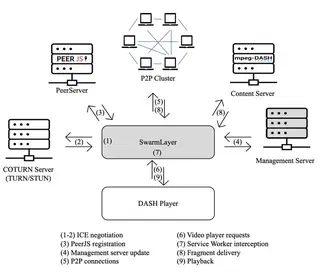
The escalating demand for multimedia content requires efficient and scalable distribution solutions for adaptive streaming, particularly MPEG-DASH, in web environments. This paper presents SwarmLayer, a novel hybrid peer-to-peer (P2P) assisted streaming solution designed to enhance web content distribution. SwarmLayer integrates a traditional client-server model with a P2P paradigm, where active users concurrently serve as content distribution nodes by sharing acquired video segments. This approach aims to significantly reduce the load of the origin server, minimize redundant content transmission, and optimize network bandwidth utilization. Implemented as a transparent and non-intrusive intermediate layer between the media player and the content distribution system, SwarmLayer requires no modifications to existing application logic or infrastructure. Its design leverages standard web technologies, including WebRTC for peer connectivity, Service Workers for request interception, and Protocol Buffers for efficient data serialization, along with the MPEG-DASH standard. Experimental evaluations demonstrate substantial server offload, achieving up to a 96% reduction in server traffic, while maintaining seamless playback fluidity across diverse network conditions, including geographically distributed nodes and NAT environments.
Type
Publication
2025 International Conference on Modeling, Analysis and Simulation of Wireless and Mobile Systems, 507–514. IEEE

Authors
Assistant Professor
Román Belda received his degree in Computer Science in 2004 and an M.S. in Telematics in 2013 from the Universitat Politècnica de València (UPV), Spain. He obtained his Ph.D. in Telecommunications from UPV in 2021. He is currently an Associate Professor at the Universitat Politècnica de València and a member of the Institute of Telecommunications and Multimedia Applications (iTEAM). His research interests include adaptive video streaming (MPEG-DASH), low-latency and peer-assisted video delivery, Quality of Experience (QoE), mobile applications and multimedia transmission protocols.

Authors
Associate Professor
Pau Arce Vila received his Telecommunications Engineering degree in 2005, his M.S. in Communication Technologies, Systems and Networks in 2008, and his PhD in Telecommunications in 2014, all from the Universitat Politècnica de València (UPV), Spain. He is a Profesor Permanente Laboral in the Communications Department at UPV and a researcher at the Institute of Telecommunications and Multimedia Applications (iTEAM) since 2005. His research interests include multimedia QoS, adaptive video streaming (DASH), quality of experience, routing in wireless ad hoc networks, and performance evaluation of multimedia systems.

Authors
Full Professor · Head of the group
Juan Carlos Guerri Cebollada was born in Valencia, Spain in 1969. He received his M.S. and Ph.D. degrees in Telecommunication Engineering from the Universitat Politècnica de València (UPV) in 1993 and 1997, respectively. He is a Full Professor in the Department of Communications Engineering at UPV, where he teaches at the ETSI Telecomunicación. He leads the Multimedia Communications research group (COMM) of the iTEAM (Institute of Telecommunications and Multimedia Applications). His research spans multimedia communications, adaptive video streaming (DASH), quality of experience, wireless and ad hoc networks, and the application of multimedia technologies to industry, medicine, education and communications.