SVCEval-RA: an evaluation framework for adaptive scalable video streaming
November 7, 2015·

 ·
0 min read
Wilder Castellanos
Juan Carlos Guerri
Pau Arce
Abstract
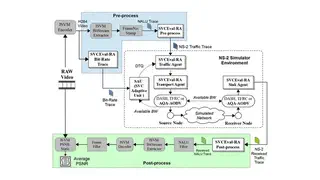
Multimedia content adaption strategies are becoming increasingly important for effective video streaming over the actual heterogeneous networks. Thus, evaluation frameworks for adaptive video play an important role in the designing and deploying process of adaptive multimedia streaming systems. This paper describes a novel simulation framework for rate-adaptive video transmission using the Scalable Video Coding standard (H.264/SVC). Our approach uses feedback information about the available bandwidth to allow the video source to select the most suitable combination of SVC layers for the transmission of a video sequence. The proposed solution has been integrated into the network simulator NS-2 in order to support realistic network simulations. To demonstrate the usefulness of the proposed solution we perform a simulation study where a video sequence was transmitted over a three network scenarios. The experimental results show that the Adaptive SVC scheme implemented in our framework provides an efficient alternative that helps to avoid an increase in the network congestion in resource-constrained networks. Improvements in video quality, in terms of PSNR (Peak Signal to Noise Ratio) and SSIM (Structural Similarity Index) are also obtained.
Type
Publication
Multimedia Tools and Applications, 76(1), 437–461. Springer Science and Business Media LLC

Authors
PhD 2015
Wilder Castellanos received his Electronic Engineering degree from the Universidad Industrial de Santander (Colombia) in 2002 and the M.Sc. in Telematics Engineering from UPV in 2009. He obtained his PhD in Telecommunications from UPV in 2015 with a thesis on QoS routing and mechanisms for improving video streaming over mobile ad hoc networks.

Authors
Full Professor · Head of the group
Juan Carlos Guerri Cebollada was born in Valencia, Spain in 1969. He received his M.S. and Ph.D. degrees in Telecommunication Engineering from the Universitat Politècnica de València (UPV) in 1993 and 1997, respectively. He is a Full Professor in the Department of Communications Engineering at UPV, where he teaches at the ETSI Telecomunicación. He leads the Multimedia Communications research group (COMM) of the iTEAM (Institute of Telecommunications and Multimedia Applications). His research spans multimedia communications, adaptive video streaming (DASH), quality of experience, wireless and ad hoc networks, and the application of multimedia technologies to industry, medicine, education and communications.

Authors
Associate Professor
Pau Arce Vila received his Telecommunications Engineering degree in 2005, his M.S. in Communication Technologies, Systems and Networks in 2008, and his PhD in Telecommunications in 2014, all from the Universitat Politècnica de València (UPV), Spain. He is a Profesor Permanente Laboral in the Communications Department at UPV and a researcher at the Institute of Telecommunications and Multimedia Applications (iTEAM) since 2005. His research interests include multimedia QoS, adaptive video streaming (DASH), quality of experience, routing in wireless ad hoc networks, and performance evaluation of multimedia systems.