Performance Evaluation of Scalable Video Streaming in Mobile Ad hoc Networks
January 1, 2016·

 ·
0 min read
Wilder Castellanos
Juan Carlos Guerri
Pau Arce
Abstract
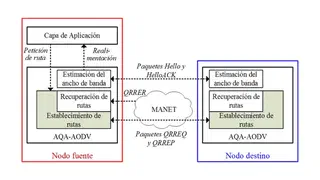
The development of video streaming services on wireless ad hoc networks is a challenge task as a consequence of different limitations such as bandwidth-constrained, variable capacity links and energy-constrained operation. Moreover, the dynamic topology of nodes causes frequent link failures and high error rates. We propose in this paper a performance evaluation of the scalable video streaming over mobile ad hoc networks. In particular, we focus on the rate-adaptive strategy for streaming scalable video (H.264/SVC). In order to provide QoS mechanisms in the routing process, a new routing protocol is introduced. This protocol estimates the available bandwidth value, which is sent to video source in order to adapt the bit rate during the video transmission. We also propose a simulation framework that supports evaluation studies for scalable video streaming. In the simulation experiments, SVC streams with combined scalability (quality and temporal scalability) were used. As quality scalability method, we used Medium Grain Scalability (MGS). The results reveal that the rate-adaptive method helps avoid or reduce the congestion in MANETs obtaining a better quality in the received videos.
Type
Publication
IEEE Latin America Transactions, 14(1), 122–129. Institute of Electrical and Electronics Engineers (IEEE)

Authors
PhD 2015
Wilder Castellanos received his Electronic Engineering degree from the Universidad Industrial de Santander (Colombia) in 2002 and the M.Sc. in Telematics Engineering from UPV in 2009. He obtained his PhD in Telecommunications from UPV in 2015 with a thesis on QoS routing and mechanisms for improving video streaming over mobile ad hoc networks.

Authors
Full Professor · Head of the group
Juan Carlos Guerri Cebollada was born in Valencia, Spain in 1969. He received his M.S. and Ph.D. degrees in Telecommunication Engineering from the Universitat Politècnica de València (UPV) in 1993 and 1997, respectively. He is a Full Professor in the Department of Communications Engineering at UPV, where he teaches at the ETSI Telecomunicación. He leads the Multimedia Communications research group (COMM) of the iTEAM (Institute of Telecommunications and Multimedia Applications). His research spans multimedia communications, adaptive video streaming (DASH), quality of experience, wireless and ad hoc networks, and the application of multimedia technologies to industry, medicine, education and communications.

Authors
Associate Professor
Pau Arce Vila received his Telecommunications Engineering degree in 2005, his M.S. in Communication Technologies, Systems and Networks in 2008, and his PhD in Telecommunications in 2014, all from the Universitat Politècnica de València (UPV), Spain. He is a Profesor Permanente Laboral in the Communications Department at UPV and a researcher at the Institute of Telecommunications and Multimedia Applications (iTEAM) since 2005. His research interests include multimedia QoS, adaptive video streaming (DASH), quality of experience, routing in wireless ad hoc networks, and performance evaluation of multimedia systems.