Performance evaluation of AL-FEC LDPC codes for push content applications in wireless unidirectional environments
January 1, 2012·


 ·
0 min read
Ismael de Fez
Francisco Fraile
Román Belda
Juan Carlos Guerri
Abstract
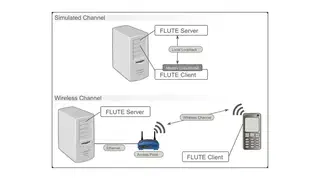
FEC (Forward Error Correction) mechanisms improve IP content transmission reliability through the recovery of packets lost in transmission. Opposite to ARQ (Automatic Repeat Request), FEC mechanisms are especially suited to unidirectional environments or to multicast environments where multiple receivers perceived different channel losses, thus making difficult the implementation of mechanisms based on feedback information. Among the different types of FEC codes, this paper presents a thorough performance evaluation of LDPC (Low Density Parity Check) codes, based on an implementation developed by the authors, according to the specifications defined by RFC 5170 for the usage of LDPC codes by push content applications based on the FLUTE protocol. LDPC codes provide a good trade-off between performance and complexity, hence, they are appropriate for mobile applications. Contributions of this paper include tests conducted with commercial mobile phones connected to the push content download server over a Wi-Fi network. The evaluation highlights the advantages of using packet level FEC encoding in file transmission over unidirectional networks and provides with a comparison between two kinds of LDPC structures: Staircase and Triangle. This is accomplished by calculating the inefficiency ratio of these LDPC structures in different environments. Results show that the implemented LDPC codes can provide inefficiency ratios close to one when the different coding parameters (as the code rate or the number of blocks) are configured to an optimal value that depends on the packet loss rate.
Type
Publication
Multimedia Tools and Applications, 60(3), 669–688. Springer

Authors
Associate Researcher · Master’s Director at VIU
Ismael de Fez was born in Valencia, Spain in 1983. He received his Telecommunications Engineering degree in 2007 and his M.S. in Telematics in 2010 from the Universitat Politècnica de València (UPV), where his M.Sc. thesis was awarded by the Telefónica chair of UPV. He obtained his PhD in Telecommunications from UPV in 2014 and an MBA from UPV in 2017. He worked as an R&D Engineer at the Institute of Telecommunications and Multimedia Applications (iTEAM, UPV) from 2008 to 2021. Since 2021 he has been Director of the Master’s in Development of Web Applications and Services at the Valencian International University (VIU). His research interests include multimedia transmission, DASH adaptive streaming, QoE modelling, AL-FEC coding for unidirectional wireless environments, and file encoding.

Authors
PhD 2013
Francisco Fraile obtained a degree in Telecommunication Engineering from UPV, an M.S. in Microwave Engineering from the University of Gävle (2004), an M.S. in Telematics from UPV (2009) and his PhD in Telecommunications (2013). From 2004 to 2010 he worked for the Swedish company Interactive TV Arena, and in 2006 he joined COMM. His work focused on DVB and IP networks for the delivery of television content.

Authors
Assistant Professor
Román Belda received his degree in Computer Science in 2004 and an M.S. in Telematics in 2013 from the Universitat Politècnica de València (UPV), Spain. He obtained his Ph.D. in Telecommunications from UPV in 2021. He is currently an Associate Professor at the Universitat Politècnica de València and a member of the Institute of Telecommunications and Multimedia Applications (iTEAM). His research interests include adaptive video streaming (MPEG-DASH), low-latency and peer-assisted video delivery, Quality of Experience (QoE), mobile applications and multimedia transmission protocols.

Authors
Full Professor · Head of the group
Juan Carlos Guerri Cebollada was born in Valencia, Spain in 1969. He received his M.S. and Ph.D. degrees in Telecommunication Engineering from the Universitat Politècnica de València (UPV) in 1993 and 1997, respectively. He is a Full Professor in the Department of Communications Engineering at UPV, where he teaches at the ETSI Telecomunicación. He leads the Multimedia Communications research group (COMM) of the iTEAM (Institute of Telecommunications and Multimedia Applications). His research spans multimedia communications, adaptive video streaming (DASH), quality of experience, wireless and ad hoc networks, and the application of multimedia technologies to industry, medicine, education and communications.