Buffering Technique for Optimizing Energy Consumption in the Transmission of Multimedia Traffic in Ad-Hoc Networks
January 1, 2015·

 ·
0 min read
Santiago González
Pau Arce
Juan Carlos Guerri
Abstract
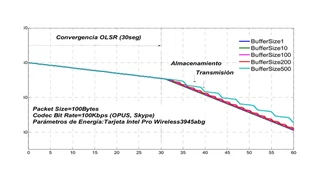
Energy constraints on wireless nodes represent a current field of research. Such restrictions are particularly significant because of the great amount of features and applications currently available on devices, which contribute to dramatically increase energy consumption. However, when transmitting delay-sensitive data, such as multimedia streaming, a balance between energy optimization and quality of service is required. In this sense, there are many works that address this issue from different layers of network architecture separately; however, a more efficient solution could be achieved by combining the management capabilities of the different layers and the joint use of such information, which is called a cross-layer mechanism. Moreover, despite the fact that the IEEE 802.11 standard defines an energy management mechanism at MAC level, it is envisaged only for structured networks, leaving just general guidelines for other kind of networks, such as Ad-Hoc networks. Therefore, as a first step towards the design of a cross-layer scheme, this paper analyzes the flaws of IEEE 802.11 standard as regards the infrastructureless mode and proposes an optimization mechanism for energy management in Ad-Hoc networks. The proposed approach is based on a buffering mechanism, which is able to increase power-saving periods of time in Ad-Hoc nodes. Simulations using NS3 indicate that it is possible to obtain higher levels of residual energy at the end of a transmission using the proposed scheme.
Type
Publication
IEEE Latin America Transactions, 13(1), 250–258. Institute of Electrical and Electronics Engineers (IEEE)

Authors
PhD 2017
Santiago González Martínez received the Electronic Engineering degree from the Universidad Politécnica Salesiana (Ecuador) in 2006, an M.S. in Advanced Computer Technologies from the Universidad de Castilla-La Mancha in 2009 and the M.S. in Telematics from UPV in 2013. He joined COMM in 2013 and obtained his PhD in Telecommunications from UPV in 2017, working on energy efficiency and QoS in wireless ad hoc networks.

Authors
Associate Professor
Pau Arce Vila received his Telecommunications Engineering degree in 2005, his M.S. in Communication Technologies, Systems and Networks in 2008, and his PhD in Telecommunications in 2014, all from the Universitat Politècnica de València (UPV), Spain. He is a Profesor Permanente Laboral in the Communications Department at UPV and a researcher at the Institute of Telecommunications and Multimedia Applications (iTEAM) since 2005. His research interests include multimedia QoS, adaptive video streaming (DASH), quality of experience, routing in wireless ad hoc networks, and performance evaluation of multimedia systems.

Authors
Full Professor · Head of the group
Juan Carlos Guerri Cebollada was born in Valencia, Spain in 1969. He received his M.S. and Ph.D. degrees in Telecommunication Engineering from the Universitat Politècnica de València (UPV) in 1993 and 1997, respectively. He is a Full Professor in the Department of Communications Engineering at UPV, where he teaches at the ETSI Telecomunicación. He leads the Multimedia Communications research group (COMM) of the iTEAM (Institute of Telecommunications and Multimedia Applications). His research spans multimedia communications, adaptive video streaming (DASH), quality of experience, wireless and ad hoc networks, and the application of multimedia technologies to industry, medicine, education and communications.