Evaluación de la QoE en un sistema de streaming adaptativo de vídeo 3D basado en DASH
July 1, 2022· ·
0 min read
Paola Guzmán
Abstract
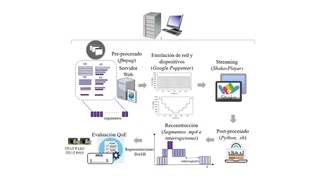
The distribution of multimedia content, and in particular video streaming, currently dominates global Internet traffic and will become even more important in the future. Thousands of titles are added monthly to major service providers such as Netflix, YouTube and Amazon. In addition to the consumption of high-definition content becoming the main trend, an increase in the consumption of 3D content can be observed again. This fact has caused that issues related to content production, encoding, transmission, Quality of Service (QoS) and Quality of Experience (QoE) perceived by users of 3D video distribution systems became a research topic with numerous contributions in recent years. This thesis addresses the problem of providing 3D video streaming services under variable bandwidth network conditions. In this sense, it presents the results of the evaluation of the QoE perceived by the users of 3D video systems, analyzing mainly the impact of the effects introduced in two of the elements of the 3D video processing chain: the encoding stage and the transmission process. To analyze the effects of the encoding process on the quality of 3D video, the first stage deals with the objective and subjective evaluation of video quality, comparing the performance of different encoding standards and methods, in order to identify those that achieve the best ratio between quality, bit rate and encoding time. Also, in the context of transmission in a simulcast environment, the advantages of using asymmetric coding for 3D video transmission is evaluated as an alternative for bandwidth reduction while maintaining overall quality. Secondly, for the study of the impact and performance of the transmission process, the work has been carried out on the basis of an adaptive dynamic over HTTP (DASH) transmission system in the context of both 2D and 3D video transmission, using different bandwidth variation scenarios. The aim has been to develop a framework for the evaluation of QoE in 3D adaptive video streaming scenarios, which allows analyzing the impact on the user’s QoE against different bandwidth variation patterns, as well as the performance of the adaptation algorithm under these scenarios. The work focuses on identifying the impact on the user’s Quality of Experience in aspects such as: frequency, type, range and temporal location of bandwidth variation events. The proposed system allows to perform performance measurements in an automated and systematic way for the evaluation of DASH systems in the 2D and 3D video distribution service. The tool Puppeteer, the Node.js library developed by Google, has been used, which provides a high-level API to automate actions in the Chrome Devtools protocol, such as starting playback, causing bandwidth changes and saving the results of the quality change processes, timestamps, stops, etc. From this data, a further processing is performed that allows the reconstruction of the displayed video, as well as the extraction of quality metrics and the evaluation of the QoE of the users using the ITU-T P.1203 recommendation.
Type
Publication
Universitat Politècnica de València

Authors
Former Senior Researcher (2011–2022)
Paola Guzmán Castillo received her Electronic Engineering degree and M.Sc. in Electronic Engineering from Universidad Industrial de Santander (UIS), Colombia, in 2001 and 2005, the Master in Technologies, Systems and Communication Networks in 2014 and the PhD in Telecommunications in 2022 from the Universitat Politècnica de València. Since 2011 she worked as a senior researcher in the COMM group. Her research focuses on QoS and QoE for 3D video streaming and adaptive transport of 3D video over IP networks.